Wednesday, 25 March 2020

Starting March 30: New Muni Service Changes

Starting March 30: New Muni Service Changes
By

Map showing bus shuttles substitutions for all Muni Metro routes
Muni Metro bus substitutions and other service changes are coming next week

Starting next week, the SFMTA will implement additional service changes during the COVID-19 shelter-in-place order. In response to changing ridership, these service adjustments will help us to focus resources on routes outside of the downtown area that are connecting people to essential jobs and services.

Beginning on Monday, March 30, all Muni Metro and light rail routes will be replaced by buses. Customers can take bus substitutions for the J, KT, L, M, and N lines using the same bus stops as the early morning Metro bus service. Muni Metro subway stations will be closed, except for downtown stations which will remain open to customers taking BART during their operating hours.

Closing the Muni Metro underground system will allow us to redirect custodial resources to other, higher-use facilities and minimizes risk to our station agents. Based on our ridership data and observations, we do not expect these changes to impact the ability of our riders and operators to maintain social distance. And while the rail system is closed to passengers, we plan on doing important maintenance work to our vehicles and infrastructure. It’s a unique opportunity to improve the state of good repair of our system and come out of this shutdown stronger than ever. 

Muni Rapid routes—the 5R, 9R, 28R, and 38R—will also be temporarily discontinued, except for the 14R Mission Rapid. Riders can instead use local service for all stops during all hours of service. The 5 Fulton and 9 San Bruno will begin running longer buses to help maintain social distancing for the health care providers, critical service workers and others who still rely on public transit to get around the city for essential needs.

Beginning Saturday, April 4, the 47 Van Ness will be temporarily discontinued on Saturdays and Sundays. The northern part of the 49 Van Ness route will be extended between North Point and Fisherman’s Wharf to cover the 47 segment on weekends.

Map showing the 49 extension that covers the northern segment of the 47 between North Point and Fisherman’s Wharf on weekends

Starting April 4 on weekends, the 47 will be discontinued and the 49 extended to Fisherman’s Wharf

We are so grateful to our operators and our customers during this challenging time. Minimizing the risk of transmission for our operators and our riders is our top priority—in addition to the extra cleaning protocols we’ve implemented in recent weeks, we are requiring operators to always use their security partitions to minimize the risk of transmission to staff and the public. Similarly, we replaced cable car and historic streetcars with buses, so that every operator has access to a protective barrier. Operators can skip stops if their vehicles become too crowded to maintain social distancing.

Please remember to stay at home except for essential trips, especially if you are over 60 or have a chronic health condition.

We continue to monitor and make adjustments as the situation develops. For details on which Muni routes are currently affected, please visit our Reduced Muni Service page. (This page will be updated with the new service change details on Saturday, March 28.)


Published March 25, 2020 at 06:52PM
https://ift.tt/2QLWNpb

Coronavirus – Confirmed Case

Coronavirus – Confirmed Case
By

From the onset, SFMTA teams moved quickly to secure supplies, encourage social distancing and make operational changes to minimize the risk of transmission and exposure to all our staff and the community.  

We also knew that once there were confirmed cases in San Francisco, it was inevitable that at some point at least one member of our staff would be directly affected. 

We can now confirm that someone in our SFMTA family has tested positive on March 24th for COVID-19. Our teams responded swiftly and appropriately and are in coordination with the Department of Public Health.

In addition to our quick reactions, we have proactively implemented numerous measures to reduce health risks for our dedicated Muni operators and other SFMTA staff who continue to keep our city moving, including:

  • Directed high-risk or sick employees to stay home, and implemented telecommuting for eligible staff  
  • Mandated that all operators close the security barrier or cab between the operator and the public. We should be very proud that we have these – other systems across the world are being challenged to come up with protective solutions in the absence of the kinds of barriers that we invested in years ago.
  • Replaced service from vehicles that do not have barriers, such as the cable car and historic streetcar lines, with buses to better protect everyone
  • Despite national shortages of cleaning supplies, we continue to provide disinfectant wipes to our transit operators daily at pull-outs. And, we are coordinating with our sister City agencies to ensure that SFMTA is a priority for additional supplies as they become available.
  • Prepared and distributed 900 spray bottle kits consisting of CDC- listed disinfectant cleanser to support additional cleaning at our transit divisions, facilities, and our non-revenue vehicles (vehicles like the ones our Parking Control Officers operate), and procured enough supplies to create an additional 450 kits  
  • Created public health campaigns reminding riders about best practices to reduce the risk of COVID transmission – these car cards and multi-lingual announcements are now featured on buses and light rail vehicles

In addition to these measures, we are working on additional steps to continue to minimize the risk of transmission within the community that include:

  • Monitoring capacity within each type of Muni vehicle to support social distancing  
  • Prioritizing service to lines that are more frequently used right now based on data and field observations  
  • Installing signs on the vehicles to remind passengers to keep distance between themselves and other riders/Muni operators  
  • Overnight cleaning of all vehicles and vehicle cleaning at terminals at the end of the line, when possible.

We will continue to monitor the situation in order to quickly update our policies and protocols as appropriate. Please visit sfmta.com/COVID19 for the latest agency updates.


Published March 25, 2020 at 11:28AM
https://ift.tt/3bwsScx

Friday, 20 March 2020

New Preventative PSA Campaign

New Preventative PSA Campaign
By Amy Fowler

Stop the spread of germs

The SFMTA launches preventative PSA campaign on how to slow the spread of COVID-19

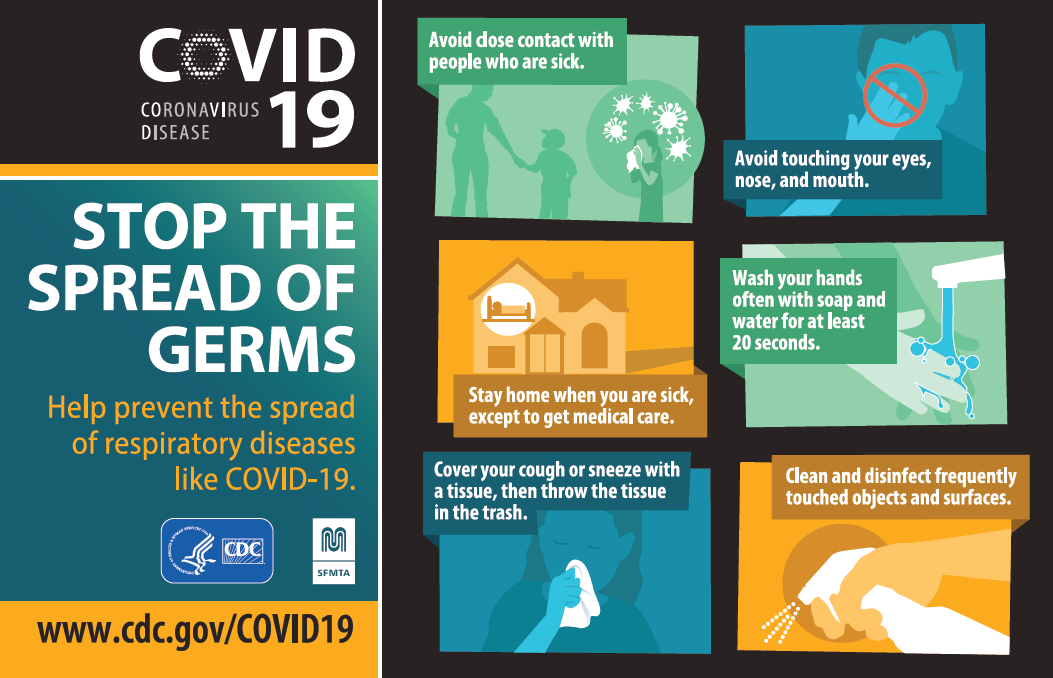
The SFMTA, in collaboration with the San Francisco Department of Public Health and Centers for Disease Control and Prevention (CDC), has launched a “Stop the Spread of Germs” Public Service Announcement (PSA) campaign on Muni vehicles to keep city residents informed about how they can help slow the spread of novel coronavirus (COVID-19).

These preventative messages are going up throughout our system—as signage both inside and outside of vehicles, audio alerts on buses, NextMuni displays at bus shelters and signs at Muni Metro stations.

While the SFMTA has implemented some service reductions in response to ridership drops, many still rely on Muni to make essential trips during this challenging period. These messages serve as helpful reminders, both on the bus and the street, that we all play an important role in preventing the spread of coronavirus.

The San Francisco Department of Public Health and the Centers for Disease Control and Prevention (CDC) recommend these simple daily precautions:

  • Wash your hands often with soap and water for at least 20 seconds.
  • Avoid touching your eyes, nose and mouth with unwashed hands
  • Cover your cough or sneeze with a tissue, then throw the tissue in the trash
  • Stay home if you are sick, except to get medical care
  • Clean and disinfect frequently touched objects and surfaces
  • Avoid close contact with people who are sick. Put distance between yourself and other people.
  • Those who are 60 and older, or with a health condition or a weakened immune system should limit outings and avoid community events
  • Please do not ride Muni if you are feeling ill, except as necessary to seek medical care after consulting with your medical provider.

We are closely monitoring what is happening with the novel coronavirus (COVID-19). Please check SFMTA.com/COVID-19 and cdc.gov/COVID19 for the latest updates.

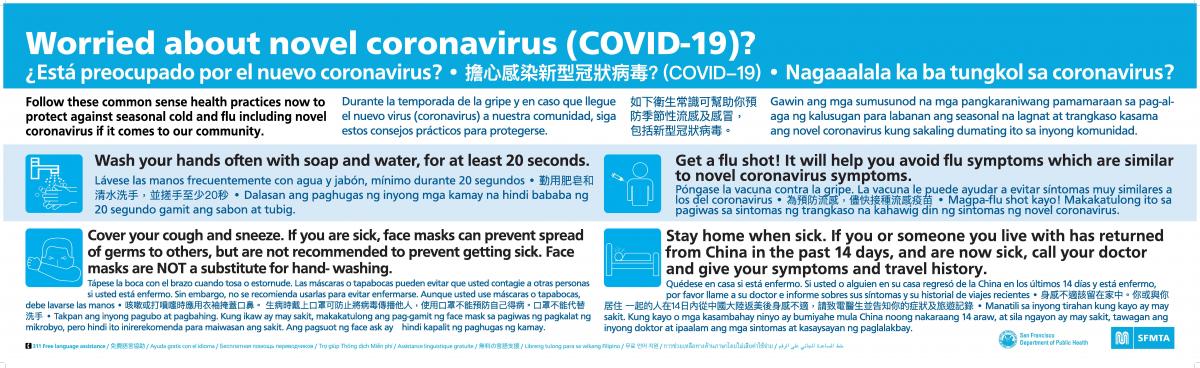
Worried about COVID-19
Signage is being installed both inside and outside of Muni vehicles and in stations to promote awareness about how to prevent the spread of coronavirus.


Published March 20, 2020 at 03:34PM
https://ift.tt/2vGNEXy

Thursday, 19 March 2020

The SFMTA Budget Process

The SFMTA Budget Process
By
We recognize the Coronavirus pandemic and current shelter-in-place order have significantly changed our daily routines. The timeline for the SFMTA budget approval has not yet changed, and as such, we are taking steps to ensure we continue to engage in a thoughtful and comprehensive community process in light of the current circumstances.  If you would like to comment on the budget, please email sfmtabudget@sfmta.com, call 415.646.2222, post on our Facebook page or Twitter #sfmtabudget @sfmta_muni.  You can also visit our Budget webpage.

Overview of the SFMTA Budget Development Process

Every two years, the San Francisco Municipal Transportation Agency (SFMTA) must finalize and adopt a consolidated budget with projected revenues and expenditures for the following two years[1]. Currently the FY2021 & FY2022 budget process is underway, and community members can participate in the budget process in the coming weeks. On May 1st, the Mayor approves the budget and sends it to the Board of Supervisors for a final vote. This blog, the first in a series diving into the budget process, will provide a high-level overview of the SFMTA consolidated budget components, purpose, and development process. The blog posts that follow will build upon this overview and cover specific SFMTA budget topics:

  • Revenue, Expenditures, and our Forecast
  • Policy objectives and funding priorities
  • Overview of outreach
  • Adopted Budget and What it includes

What is the SFMTA Budget Process?

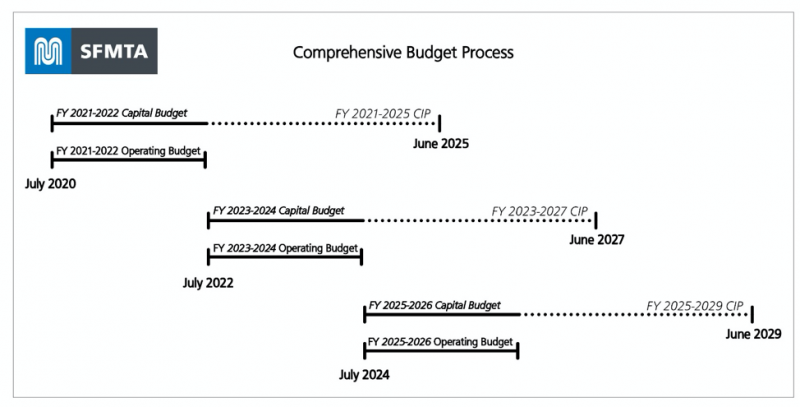
The consolidated budget covers a two-year period and has two parts: the Operating and the Capital budgets. The Capital budget is for new and on-going projects; the Operating budget is for daily services[2] and maintenance. For example, buying new LRV4 trains to replace our light rail fleet is within the Capital budget, while the salaries of our train operators is within the Operating budget. As the example shows, the Operating and Capital budgets are developed in tandem for the SFMTA’s budget process.

SFMTA Comprehensive Budget Process graph

Additionally, the Capital budget reflects the first two years of the five-year Capital Improvement Plan (CIP). The CIP is a policy document detailing the projects that the agency aims to implement over the five-year period and is based on city-wide planning initiatives & project-specific feedback. A new CIP is developed each budget cycle, meaning that the outer three years of the current CIP are reevaluated, adjusting projects to evolving policies and conditions. For example, as the need for our new LRV4 trains became more urgent, we changed our plan so that the trains could be bought sooner.

The five-year CIP and two-year Capital and Operating budget documents show how the SFMTA plans to allocate available resources to meet our Strategic Plan goals. Both the consolidated budget and the CIP are submitted to the SFTMA Board for approval. Following this, the budget is submitted to the Mayor and the Board of Supervisors for review and approval.

Why does the budget matter?

The budget is the strongest reflection of our values. It is a commitment and a plan for how we will dedicate resources to better serve the public. The SFMTA’s projects and services are limited by funding[3], requiring the SFMTA to make difficult choices about what needs should be prioritized and funded. The budget details how and when we will implement relevant projects and meet our goals.

How does SFMTA develop the budget?

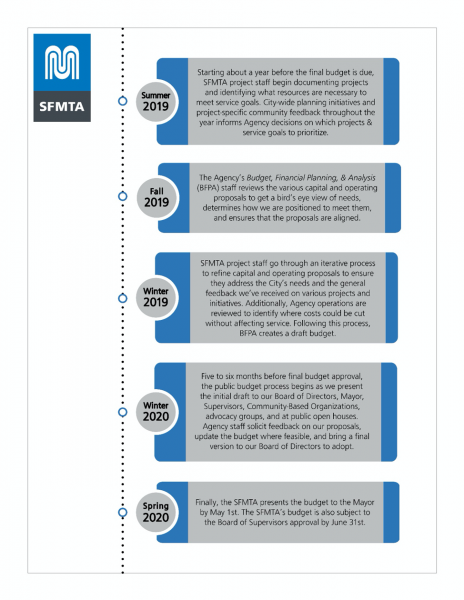
Generally, the budget is developed through the following 5 steps:

Budget Timeline

Where to find additional information

In the upcoming weeks, we will be publishing additional blogs that will provide more detail on specific aspects of the budget process. For additional questions, please review the following documents or email sfmtabudget@sfmta.com.

  • SFMTA Strategic Plan (2018)
    • Details our vision, what we need to do to get there and how we will measure progress along the way.
  • SFMTA Board of Director's Presentation (3/17/2020)
    • The most recent public presentation of the proposed budget (FY21 and 22) along with the challenges and decisions that the board will have to facilitate.
  • SFMTA 20-year capital plan (2017)
    • This is a fiscally unconstrained assessment of the SFMTA’s anticipated capital needs in the next 20 years. It identifies the investment needed to meet the agency’s and city’s transportation goals, and informs the Capital side of each two-year comprehensive budget
  • SFMTA 5-year Capital Improvement Program (2019)
    • This details the fiscally constrained set of projects that the agency aims to implement by June 30th, 2024, based on city-wide planning initiatives & project-specific feedback.
  • SFMTA Performance Metrics
    • These interactive dashboards track the agency’s progress in meeting its goals and objectives as outlined in the Strategic Plan
  • SFMTA Automatic Indexing Policy
    • For more information on how the agency sets charges based on inflation
  • SFMTA Contingency Reserve Policy
    • For more information on how the agency works to ensure financial stability

Coming up next in our series: Revenue & Expenditures


[1] The 2-year budget cycle is required as a result of voters passing 2009’s Proposition A

[2] Per City Charter, the types of services that the SFMTA provides are mandated

[3] Per City Charter, the SFMTA budget must be balanced, meaning that projected expenditures must be no greater than our projected revenues.


Published March 19, 2020 at 06:42PM
https://ift.tt/2QxyN8X