Wednesday, 15 April 2020

Update: Route and Stop Changes

Update: Route and Stop Changes
By Bradley Dunn

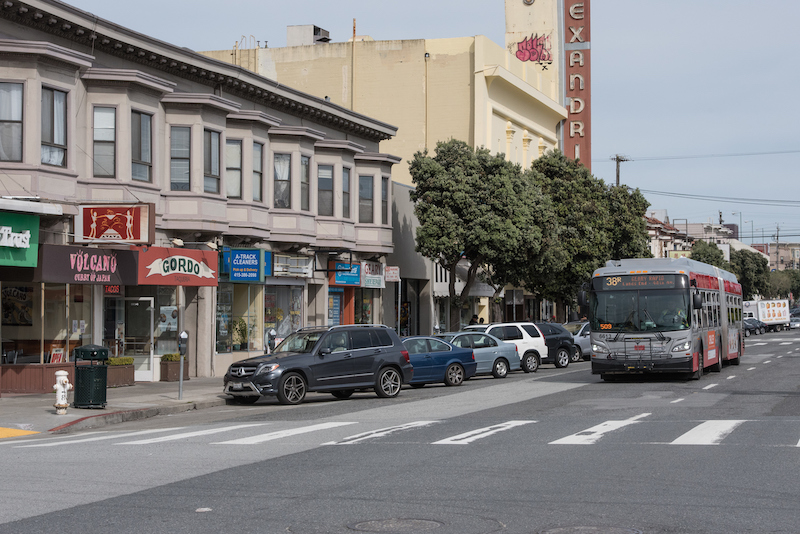
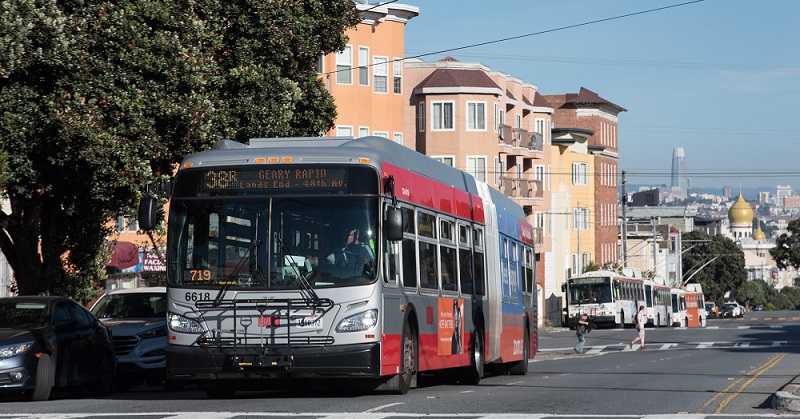
38 Geary Rapid in the Richmond District

With a shortage of operators, car cleaners and other key personnel, Muni has implemented significant reductions to Muni service. The COVID19 pandemic has disrupted many parts of everyday life, including transit. As everyone is getting used to our new Muni Core Service Plan, some key routes are continuing to run but are using different stops. And, other changes have been made in response to customer feedback.  

As a reminder, during this public health emergency, we are asking San Franciscans to: 

  1. Comply with the shelter-in-place directive 

  1. Only make essential trips 

  1. Use Muni only for those essential trips that can’t be made in other ways 

The following changes went in effect on Wednesday, April 8. All of these are in place until further notice with mulit-lingual signs-up at all stops detail the service. 

K Ingleside Bus Temporarily Discontinued, T Bus Operating to Castro 

The Muni Core Service Plan temporarily suspends K Ingleside service. The T Third Bus will operate service to Castro and Market.  For service to the Forest Hill and West Portal neighborhoods, riders should transfer to the L Taraval Bus from Market & Castro. For service to City College, transfer to the 49 Van Ness/Mission at Van Ness and Oak﷟HYPERLINK "https://www.sfmta.com/stops/van-ness-ave-oak-st-16821"

L Taraval Bus Stops in Twin Peaks 

The L Taraval Bus is making more stops than our standard L Taraval replacement bus.  Recognizing that there are fewer choices with our core service plan, stops were added to the L Taraval Bus route to provide more transit service to the Twin Peaks area between West Portal and Castro. Additional Twin Peaks area stops can be found here

N Judah Bus Temporary Extension in the Haight 

The N Judah Bus has added additional stops to fill service gaps along Haight Street. This should be useful to people who usually rely on the 7 Haight/Noriega. These stops are in addition to the usual N Judah Bus replacement service stops. See the N Judah Bus’ additional Haight neighborhood stops here. 

8 Bayshore Inbound Reroute to Stockton Street 

The 8 Bayshore was rerouted inbound (going north) via Stockton Street between Market and Columbus to serve riders heading towards Chinatown. This should help people who usually ride the 30 or 45. More information about added stops are available here.  

9 San Bruno Extension to McLaren Park 

Before the pandemic, the 9 San Bruno line terminated at Bayshore and Sunnydale on weekdays. The 9R San Bruno Rapid had carried riders to the Cow Palace and McLaren Park.  With our new Core Service Plan discontinuing the 9R, the 9 San Bruno will run its weekend route, proving service to McLaren Park.  You can find out more about the changes on the 9 San Bruno Page

38 Geary and 38 Geary Rapid to 48th Ave & Pt. Lobos 

To provide an additional option for riders, the 38R Geary Rapid returned to service to supplement the 38 Geary. The 38R Geary Rapid will serve Rapid stops only, and the 38 Geary will serve all local stops. Both the 38 Geary and 38R Geary Rapid lines will terminate on 48th Avenue at Pt. Lobos, but the  38 will serve Fort Miley Circle near the VA Hospital first before proceeding to the terminal. More info on the 38 Geary page

49 Van Ness/Mission Extension to Fisherman's Wharf 

For those going to Fisherman’s Wharf, the 49 Van Ness/Mission has been extended to serve many of the 47 Van Ness stops in that area. To see where the additional stops are you can look at the 49 Van Ness/Mission page. 

44 O'Shaughnessy Temporary Terminal at Forest Hill Station 

The 44 O'Shaughnessy is extending farther than originally planned (only to Balboa Park) as part of the COVID-19 Muni Core Service Plan. It now operated between the Bayview and Forest Hill Station. Stops north of Forest Hill Station will not be served. By ending the northern part of the line at Forest Hill Station, we are able to preserve service to Laguna Honda Hospital from the south. To learn more, you can look at the 44 O’Shaughnessy’s page. 

Next Steps and Tips for Getting Around 

SFMTA staff is monitoring and implementing service changes on a faster timeline than normal to respond to the public health emergency. We have made major efforts to post multilingual signage. Please take note of any SFMTA signage posted at bus stops to inform riders of any recent changes and their effective dates. We are also regularly replenishing signage and taking down outdated signage for thousands of stops throughout the city.  

As our customer information systems require time to update accurate stops and route information, you may see inaccuracies in NextBus and headsign displays on buses until system updates are complete. Refer to posted expected frequenices and ask operators to confirm their destination if the headsign on the bus says “Ask Driver for Terminal.”  

We understand that our riders have different reactions to these changes.  For some, the changes will be less convenient or eliminate service that people rely on. For others, these changes add important connections for taking essential trips.  We are trying to balance our service to provide as much essential service as possible given the greater demand for vehicles to support social distancing and our shortage of operators, car cleaners, and other key staff needed to keep the system running. We encourage you to follow our social media channels to get the latest on upcoming service changes. We are all in this together and appreciate your patience during this public health crisis. Thank you! 


Published April 15, 2020 at 07:18PM
https://ift.tt/34FkLrD

Thursday, 9 April 2020

Director of Transportation Report: April 8, 2020

Director of Transportation Report: April 8, 2020
By

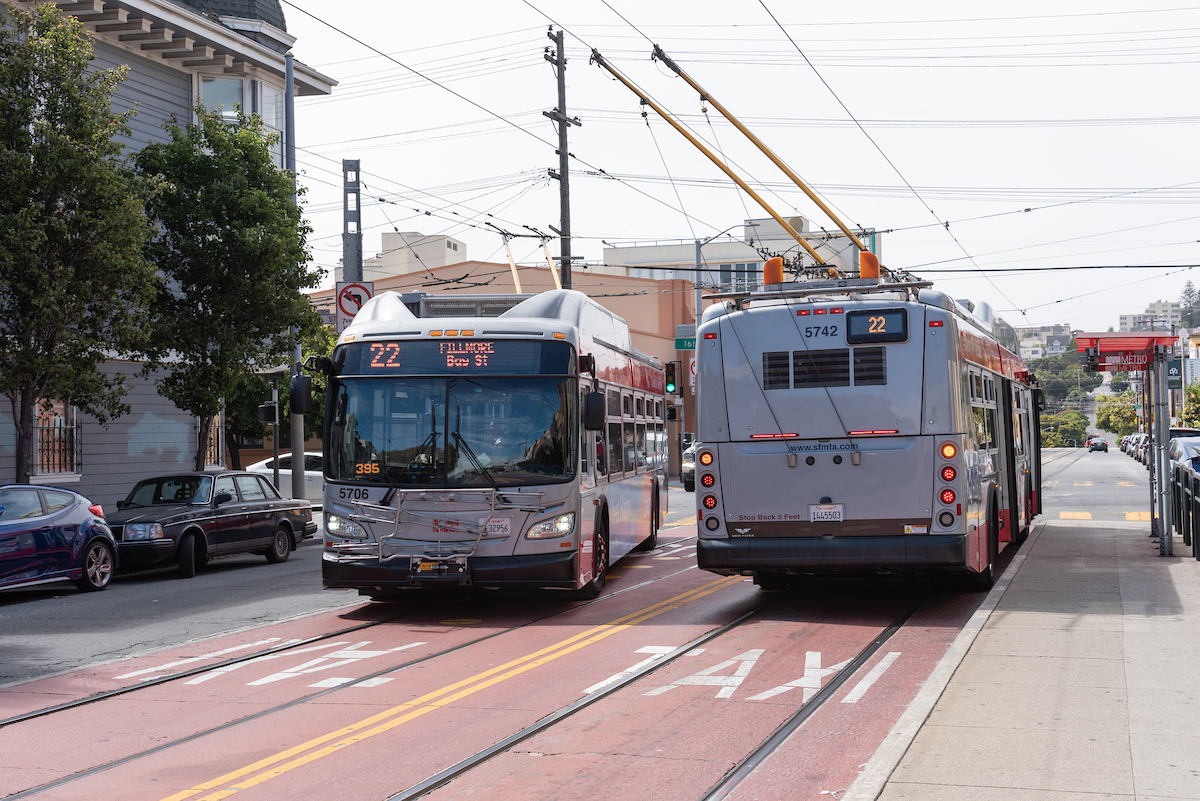
22 Fillmore zero emission coaches

In this week's Director's Report from the SFMTA Board of Director's Meeting, Jeffrey Tumlin gave updated on the following topics:

Coronavirus Response

  • Department Operations Center (DOC) activated March 13, using an incident command system responsible for planning and implementing our responses to the COVID-19 public health emergency. Priority is reducing health risks for staff and passengers while continuing to provide critical access.
  • DOC team has developed policies and standard operating procedures informed by the Department of Public Health (DPH) to reduce risk of transmission in our system, ensuring we have systems and protocols in place before we need them.
  • We now need San Franciscans to do their part by complying with the shelter-in-place orders, making only essential trips. And we need people to use Muni only for those essential trips that they cannot make by walking, biking or other modes of transportation. Now’s the time to do that so that riders like health care workers can get to where they are needed.
  • We are working on a few fronts to address our near-term and long-term financial health.
    • Fare and parking revenues are down by 80% - 90%, representing almost 50% of our budget.
    • 30% of our budget comes from the City’s General Fund, which is also expected to be severely impacted by this event.
  • We have been advocating for and are closely monitoring Federal relief funding and state support for transit agencies.
  • The CARES Act, a $2.2 trillion federal emergency relief bill signed into law March 27, includes $25 billion to support public transit. The Bay Area is expected to receive $1.3 billion in funding through existing federal formulas.
  • SFMTA working with Metropolitan Transportation Commission (MTC) to develop processes to distribute funding.
  • Supporting the hardest hit San Franciscans by suspending new late fees on citations and extending March Lifeline passes.
  • We are also tightening our own belts by looking at our budgets and taking steps to not incur overtime and reducing nonessential purchase orders.
  • We have instructed managers about what to do when a positive case is reported, we have cleaning practices in place that not only disinfect to prevent transmission but also remove barriers to deep cleaning any workspace of someone who tests positive for the virus; we also have worked with DPH to be clear on what “close contact” means for our staff, so we can provide appropriate guidance on which other staff might need to get tested or do self-quarantine.

Vision Zero

  • Rapid Response
    • Wrong-way injury collision on 10th Street March 23. Of the three parties involved, two are still receiving medical care. San Francisco Police Department is investigating.
  • Performed a rapid response but do not have any recommendations at this time. We will continue doing rapid responses, but crews will only be focusing only on essential tasks in the field.
  • Safe Streets/Safe People Update.
    • Vision Zero safety projects that require fieldwork are also delayed, including Vision Zero Street Team ambassador outreach and street projects.
    • Detailed design work being expedited as field operations temporarily slow down.
  • Temporary Bikeways
    • Following DPH’s guidelines related to construction projects, for now we are not proposing any repurposing of the right of way for temporary bike lanes or adding additional pedestrian space.

Our Board of Directors meeting is usually held on the first and third Tuesdays of each month. To watch the meeting in full, go to SFGovTV.


Published April 09, 2020 at 04:31PM
https://ift.tt/3ea1ymw

Wednesday, 8 April 2020

Navigating the New Muni

Navigating the New Muni
By

Man on bus checking his phone

Today we’re rolling out a new service plan that will operate 17 Muni core routes from 5 a.m. – 10 p.m., plus expanded evening-late night or Owl service. We are making these changes to ensure that the limited resources we have are used to provide service for essential trips on our busiest lines with the highest demand with adequate space for passengers.

We appreciate your understanding as our agency has been working diligently and as quickly as possible to develop and communicate this plan. Our blog posts on the essential core routes and the expanded Owl service have more details on these changes and our COVID-19 webpage has more information and resources, including updated service maps.

We understand that usually each of us has our preferred method for tracking our bus or timing the train we catch. We wanted to let you know what to expect from our schedules and NextMuni in the coming days. Again, we appreciate your patience as we implement these changes.

New Muni Updates & Related Data

Muni planners routinely modify routes and schedules a few times per year. From planning to implementation, this process typically takes several months. In this case, however, our response must be expedited, so we’ve restructured Muni service quickly and compressed this process into days.

Can I rely on the published schedules for the core routes?

Until they are updated in our systems over the next few days, the published schedules on our website and others such as 511.org that use on this data may be temporarily inaccurate.

We will update the schedules for our tracking and management purposes as quickly as possible. Muni service during this time will operate with attention to vehicle frequency or headways, not specific schedule times.

Will the NextMuni real-time arrival predictions work on the core routes?

On core routes, NextMuni will continue to provide predictions for buses on signs at shelters and by visiting www.nextmuni.com.

Generally speaking, we expect that the NextMuni predictions on the core routes to be accurate. However, some of the core routes are operating differently than normal. For example, the 44 O’Shaughnessy is running between the Bayview and Forest Hill Station only and the T Third bus is running between the Castro and Sunnydale. In these cases, predictions may temporarily be less accurate until all our systems are updated.

The following routes may experience inaccurate predictions: 9 San Bruno, 14R Mission Rapid, 38 Geary, 38R Geary Rapid, T Third bus, 44 O’Shaughnessy, 8 Bayshore.

Again, this should only be an issue only until we update our scheduling systems.

What about mobile apps?

The SFMTA provides digital route and schedule data to the public on an open API (Application Programming Interface). This data also relies on the schedule systems we are currently in the process of updating. Mobile apps may use this data to provide transit information to their users; however, the SFMTA does not control these independent apps and cannot guarantee their accuracy.

Our COVID-19 response and service information is covered daily in our blogposts with a more in-depth look into the changes we make and why. Consider subscribing and receiving daily blog email updates. You can also receive real-time email or text service updates, Monday – Friday, 5 a.m. – 9 p.m. and Saturday and Sunday, by subscribing to our Muni Alerts.

Our priority is to reduce risk of COVID-19 transmission to our employees and riders. We are committed to being transparent with the community as we make changes to pursue this priority. We look forward to restoring as much service as possible as soon as possible. In the meantime, these service changes are necessary to keep the system moving during this crisis.

The SFMTA asks San Franciscans to:

  1. Comply with the shelter-in-place directive
  1. Make only essential trips
  1. Use Muni for essential trips only when other options are not available

Remember, for more information on all our service changes visit SFMTA.com/COVID19.


Published April 08, 2020 at 11:10AM
https://ift.tt/2RjHpAj

Muni Core Service Plan Now in Effect

Muni Core Service Plan Now in Effect
By Bonnie Jean von Krogh

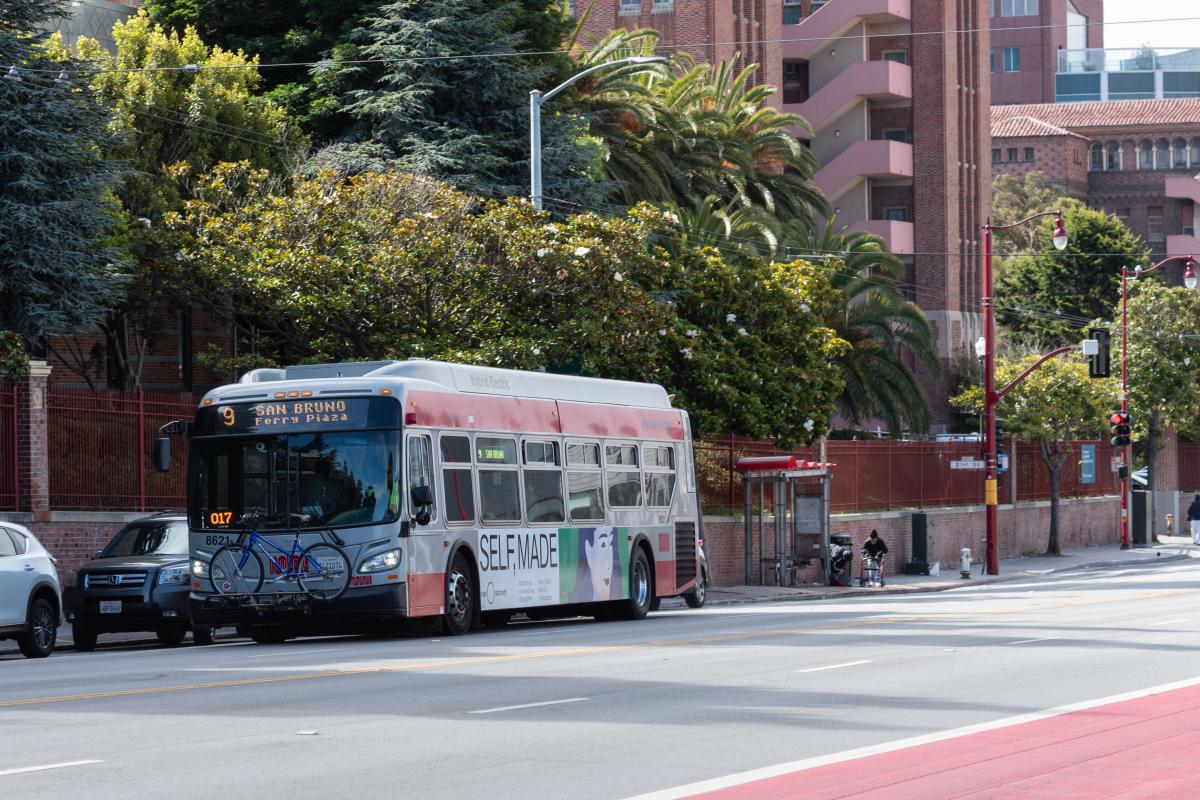
9 San Bruno at Zuckerberg San Francisco General Hospital

Muni service is undergoing dramatic changes in response to COVID-19. Many critical Muni staff including operators, mechanics, and car cleaners are more vulnerable to coronavirus due to their age or preexisting health conditions, so they are sheltering in place in accordance with the city’s order. This has made it difficult for us to fully staff all our routes.

Muni’s Core Service Plan now in place focuses SFMTA’s limited resources on providing service on our busiest lines with the highest demand during this crisis. Although we are running only about 20% of our transit lines (17 of 79 lines), last week those 17 lines carried approximately 80% of our passengers due to changing trip patterns. This core service is in support of essential trips that cannot be made in other ways. We are asking all San Franciscans to help us maintain adequate space on buses for social distancing by staying at home except for essential trips. Further, if you can take alternative transportation to Muni, please do.

Still need to travel on Muni? Check out the changes now in effect. Be sure to plan extra time for your trip which now may include transfers and a longer walk. Remember your fare is good for two hours across multiple buses.

Muni Core Service

  • View the COVID-19 Muni Core Service Plan for the 17 bus lines Muni is now running daily from approximately 5AM-10PM. Background on the changes can be found in our recent blog post.  
  • Access a larger map of the Core Service which also displays regional transit connections and can be downloaded.
  • We are working with Third Party Transit Data Providers to ensure these changes are reflected in their trip planning apps. Please note that many of the arrival predictions will be unreliable for at least a few days.

Modifications to Specific Routes

  • Check out our Travel and Transit Updates for routes that have been modified as part of the Core Service Plan – either shortened, extended or updated to serve additional stops.

Updates to Late-Night Owl Service

Alternatives to Muni

  • Paratransit service continues to operate as normal so that customers can travel for essential needs. We ask riders to cancel any non-essential trips.
  • Use Shop-a-Round for low-cost shuttle or subsidized Taxi rides to/from the grocery store for registered seniors and people with disabilities. A customer does not have to be ADA-paratransit eligible to use the service. 
  • Taxi services, including wheelchair accessible ramp taxis, continue to operate as an essential service. ​Individual taxi companies are following best practices to minimize the risks of transmission.
  • For Bikeshare and Scooter Share, please visit the websites and apps of the individual companies for whether they continue to operate and for information on availability during the COVID-19 shelter-in-place.

For more updates on all SFMTA services during this public health crisis, visit SFMTA.com/COVID19.


Published April 08, 2020 at 10:51AM
https://ift.tt/2RmxQAQ

Tuesday, 7 April 2020

Modified OWL Service to Start 4/8 at 10 pm

Modified OWL Service to Start 4/8 at 10 pm
By Bradley Dunn

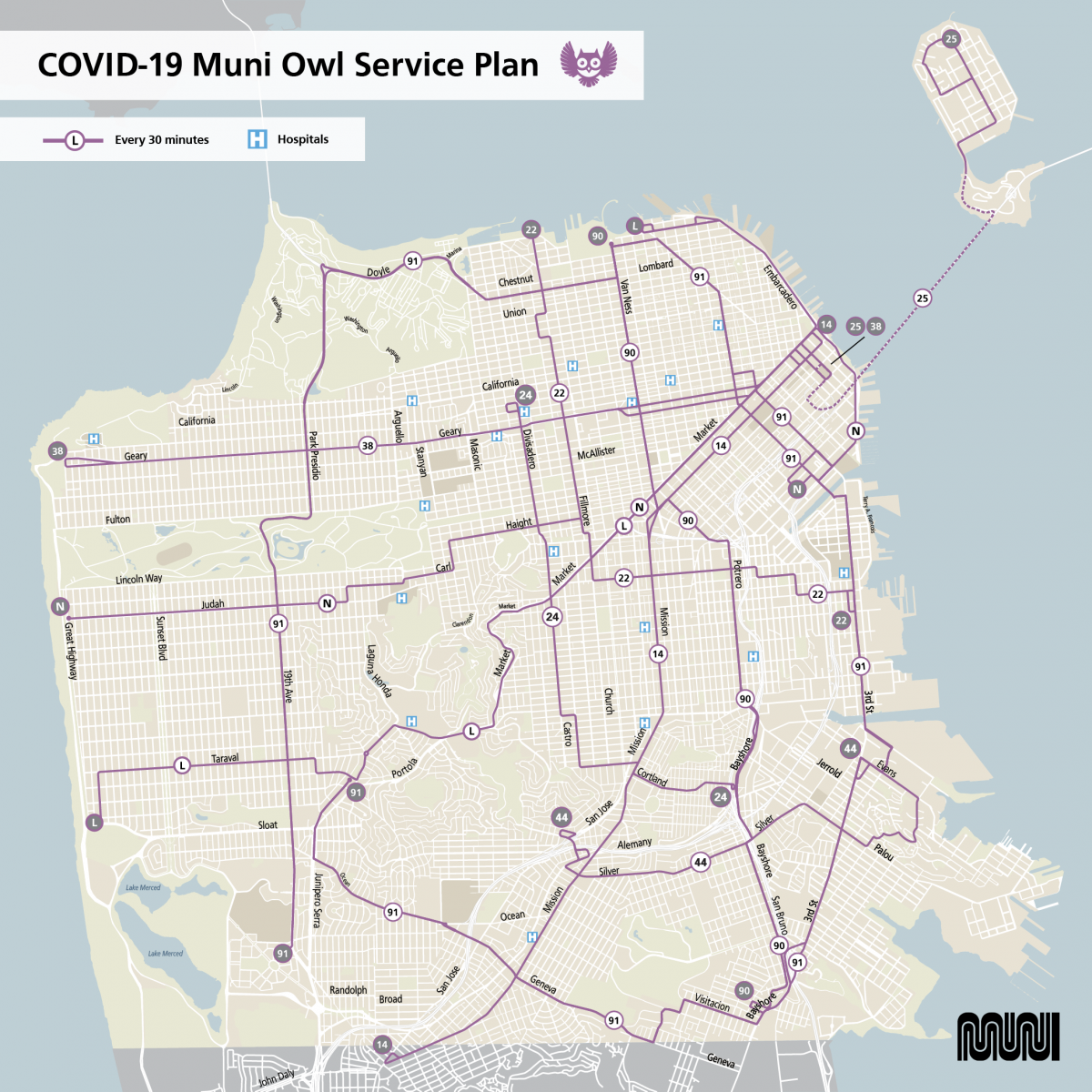
The COVID-19 public health crisis is changing ridership patterns and affecting the availability of key staff who operate, clean and maintain our buses. Due to these shifting resources and needs, the SFMTA will be starting late-night Owl service at a new, earlier time during this crisis. Instead of switching from daytime Muni service to Owl service at 1 am, beginning Wednesday, April 8, our late-night Owl routes will start every night at 10 pm. All regular Owl routes will operate with the exception of the 5 Fulton and 48 Quintara/24th Street, which will be temporarily discontinued.

We know that this and other Muni Core Service Plan changes will be difficult for many San Franciscans. We are making these changes to ensure that the limited resources we have are used to provide service for essential trips on our busiest lines with the highest demand with adequate space for passengers. 

Owl Network MapStarting Wednesday, April 8 - Map of the Owl Service to run daily from 10pm – 5am

The following lines will be running 24 hours a day or providing special Owl Service:

  • L Owl*
  • N Owl*
  • 14 Mission
  • 22 Fillmore
  • 24 Divisadero*
  • 25 Treasure Island
  • 38 Geary
  • 44 O'Shaughnessy*
  • 90 San Bruno Owl
  • 91 3rd Street/19th Avenue Owl

*Owl route is different than the daytime route. Check the map for exact alignment.

The SFMTA has instituted some of the strongest health protections for our operators, mechanics, car cleaners and customers to minimize the risk of transmission on our buses. Many of our operators are more vulnerable to COVID-19 due to their age or preexisting health conditions, so they are sheltering in place in accordance with the city’s order. This has made it difficult for us to fully staff all of our routes.

We must focus available resources on the lines that most critically serve essential trips at the most used times to provide social distancing.

Our priority is to be transparent with the community. Our goal is to restore as much service as possible as soon as possible. In the meantime, these service changes are necessary to keep the system moving during this crisis.

The SFMTA asks San Franciscans to:

  1. Comply with the shelter-in-place directive 
  1. Make only essential trips 
  1. Use Muni for essential trips only when other options are not available 

For more information on all our service changes, visit SFMTA.com/COVID19


Published April 07, 2020 at 06:55PM
https://ift.tt/2y03k8U

Monday, 6 April 2020

SFMTA Prepares to Deliver Essential Trips Muni Service Only

SFMTA Prepares to Deliver Essential Trips Muni Service Only
By Bonnie Jean von Krogh

Muni bus on Geary Boulevard

In the rapidly changing environment caused by COVID-19, the SFMTA is making additional updates to Muni service. While ridership has fallen significantly, our bus operators still serve approximately 100,000 passengers a day – getting nurses, cooks, custodians, and other essential workers to their jobs. The SFMTA has instituted some of the strongest health protections for our operators, mechanics, car cleaners and customers to minimize risk of transmission on our buses. These efforts have been paired with our continued effort to maintain regular service, so remaining essential workers have the space to maintain recommended distances on Muni.  

However, it has become increasingly difficult to continue delivering service on our current network due to operator availability and the changing trip needs of the community.  Following public health guidance, there are operators are in self-quarantine out of an abundance of caution, while others have conditions that make them especially vulnerable. We are expecting over 40% of our operators to be out in the coming week. Remaining operators will continue to be on the job doing the heroic work of keeping San Francisco moving during this crisis. 

In order to maintain service levels to provide social distance, we must focus our available resources on the lines that most critically serve essential trips. This means temporarily reducing Muni service, and prioritizing routes in most critical need during the pandemic.  

Our priority is to be fully transparent with the community. Our goal is to restore normal service as quickly as possible. However, in the interim, we will prioritize our available resources based on connections to medical facilities, Muni’s Equity Strategy, and data from customer travel patterns we’ve observed during the COVID-19 shelter-in-place order. In order to maintain frequency, and sufficient social distance on these services, we will continue to operate 17 routes, while temporarily eliminating services on others.  

Changes to Muni service are being rolled out in phases  

Monday, April 6 

Customers should prepare for delays across the Muni system both Monday and Tuesday. We expect to be below necessary staffing levels to provide adequate service. This gap will cause missed runs and delays that may not be accurately reflected in NextBus predictions. If you need to make an essential trip, plan to use other options or allow extra time when riding Muni. 

Tuesday April 7 

Service will be temporarily discontinued on seven routes that are experiencing low ridership or have nearby lines that provide similar service and connections. Routes to be discontinued include the 2 Clement, 3 Jackson, 5 Fulton, 7 Haight, 10 Townsend, 21 Hayes and 31 Balboa.  

Wednesday April 8 

Service will be further reduced to our 17 most-used lines. This core network will provide service within one mile of all San Franciscans. This approach allows Muni to continue to serve San Francisco’s medical facilities and focuses on equity to ensure service for our customers most reliant on transit. The frequency of buses will vary by line so that lines experiencing some crowding will have more frequent service than others. 

The 17 core routes that will remain in service, with some modifications include: 

N Judah Bus 22 Fillmore
L Taraval Bus 24 Divisadero
T Third Bus 25 Treasure Island
1 California 29 Sunset
8 Bayshore 38 Geary
9 San Bruno 38R Geary Rapid
14 Mission  44 O'Shaughnessy
14R Mission Rapid 49 Van Ness/Mission
19 Polk  

Map of service starting Wednesday, April 8 

More details on the exact service plan will be available soon, so stay tuned and thank you for your patience as we all get through this difficult time together.  

How San Franciscans Can Help 

We need San Franciscans to help us continue to minimize risk of COVID-19 transmission on Muni. Please remember to stay home except for essential trips that cannot be made any other way. Take alternative transportation to Muni if you can. 

  1. Comply with the shelter-in-place directive 

  1. Make only essential trips 

  1. Use Muni for essential trips only when other options are not available 

By developing a plan to deliver core Muni service with the resources available, we can continue to minimize risks of transmission and ensure our transit system works for essential trips across San Francisco. 

For more information on what were are doing and updates to SFMTA services, please visit SFMTA.com/COVID19


Published April 06, 2020 at 06:54AM
https://ift.tt/2xRsiYg

Wednesday, 1 April 2020

How We're Adapting During Coronavirus

How We're Adapting During Coronavirus
By Amy Fowler

Image of an L Taraval bus shuttle substitutionWe’re doing everything we can to reduce the risk of COVID-19 transmission, and we’re asking San Franciscans to help do the same by only taking Muni for essential trips that can’t be made by walking, biking or driving.

The SFMTA’s number one priority during the COVID-19 outbreak is the safety of our staff and the public. With this in mind, we’ve taken a number of steps, including making service changes to focus our cleaning resources, improving our operators’ environment and helping to amplify citywide shelter-in-place guidelines.

Beginning this week, all Muni Metro Light Rail routes are temporarily being served by Metro buses. Closing the Muni Metro underground system allows us to simplify our operations and refocus cleaning staff from largely empty subway stations to other critical areas, such as bus yards, field operations and other facilities that are currently seeing more activity. It also minimizes risks to our public-facing station agents. Because Muni drivers are cross-trained to handle different vehicle types, we have some flexibility in moving train operators to the bus shuttles.

In addition to the earlier Express service reductions, most Rapid routes are also temporarily discontinued, with local buses serving all stops. With Muni Metro ridership down over 90% and systemwide drops of about 75-80% compared to this time last year, we still expect to be able to support social distancing.

Fortunately, our buses are already equipped with a protective plexiglass barrier, something that most other transit agencies lack. After the shelter-in-place order, we acted quickly to minimize the risks of transmission to staff and the public by shifting cable cars and historic streetcars to buses that have the protective barriers. And despite challenges in getting supplies, we’re prioritizing getting sanitizing supplies to our operators on an ongoing basis and implementing additional cleaning procedures.

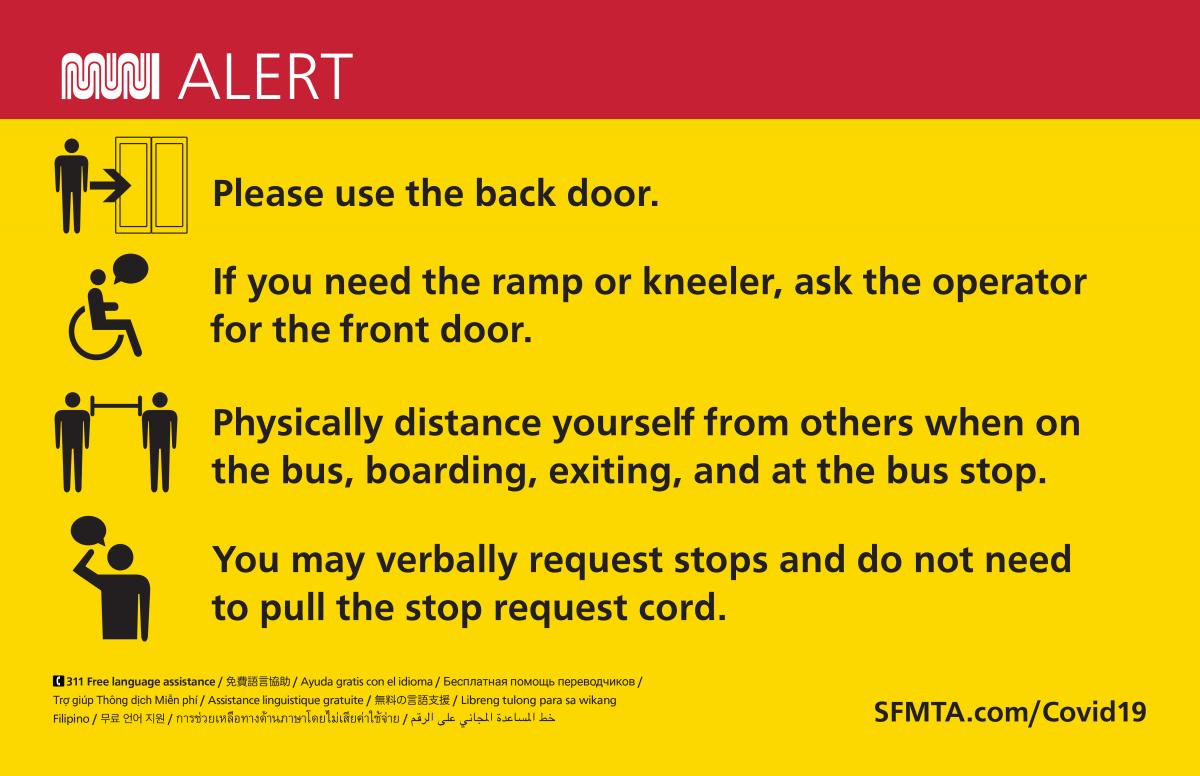
Last week we began requesting that all passengers board from one of the back doors unless they require assistance. People with disabilities and others who need the kneeling function of the bus can request boarding in the front from the operator. To help reinforce backdoor boarding and to help remind passengers about social distancing, new signs have begun going up in buses.

We’re also giving operators guidance about passenger thresholds for different vehicle types. If a bus becomes too crowded, operators can skip stops. And if needed, we’re prepared to quickly make changes to continue to support social distancing on our vehicles. We are monitoring capacity daily through automatic passenger counts and assessments from inspectors on the street. This gives us a holistic view of what is happening on the street so we can make adjustments as resources become available.

We are doing our part to reduce the risk of transmission on Muni, and we need San Franciscans to do their part too. Unlike normal times when we welcome and encourage all kinds of trip on Muni, during this public health emergency, we need San Franciscans to use Muni only for essential trips and only for trips that you can’t make by some other mode of transportation.

Please check the SFMTA COVID-19 Response page for the latest service and citation information. Or go to the SF.gov COVID-19 website for citywide resources about the shelter-in-place order.

Image of signs going into buses that says: Please use the back door. If you need the ramp or kneeler, ask the operator for the front door. Physically distance yourself from others when on the bus, boarding, exiting and at the bus stop. You may verbally request stops and do not need to pull the stop request cord. SFMTA.com/Covid19Signs are going into buses to encourage passengers to practice social distancing and use the back door for boarding.  


Published April 01, 2020 at 11:15AM
https://ift.tt/2WXrETv