Thursday, 4 January 2024

It’s Time to Modernize the Technology that Keeps Muni Metro Moving

It’s Time to Modernize the Technology that Keeps Muni Metro Moving
By Mariana Maguire

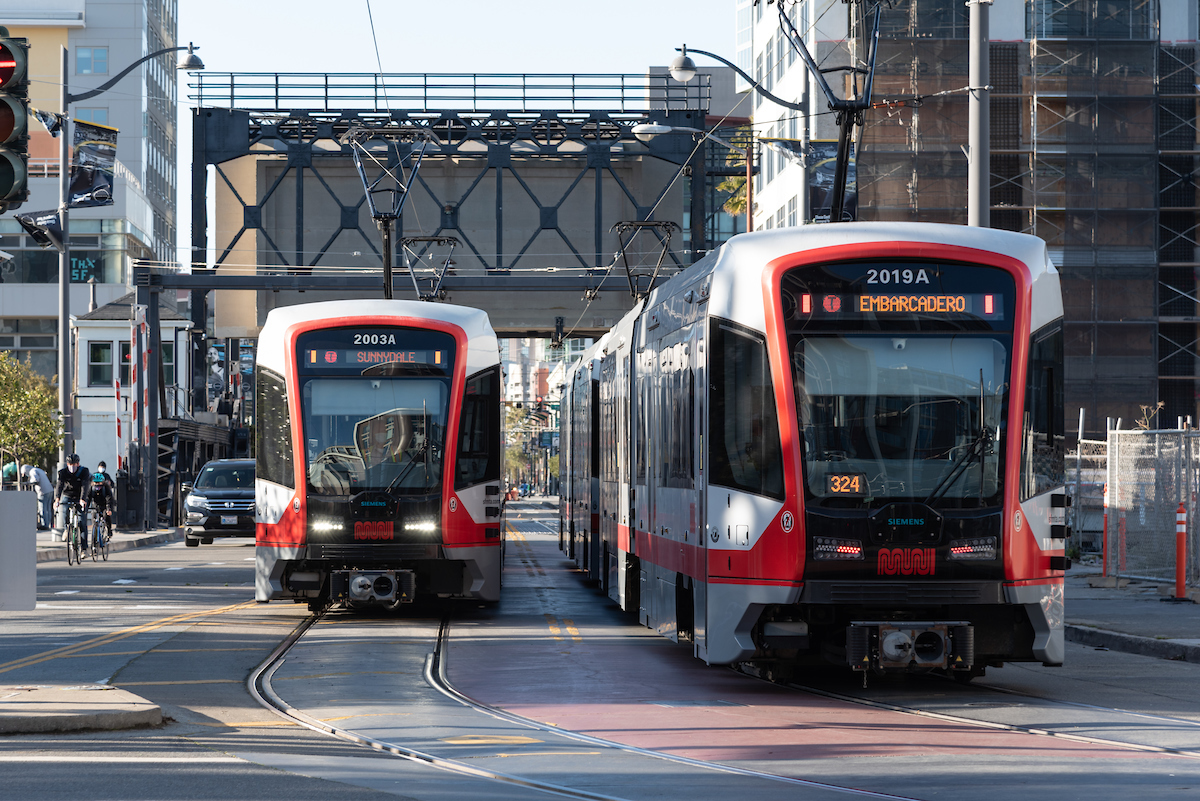
Two light-rail trains pass each other on a busy street in San Francisco with cars on the street and a bridge in the background along with tall buildings.

Upgrades will replace the current train control system in the subway and extend the modern system to street-level Metro operation for faster, more reliable service. 

Muni Metro, San Francisco’s light rail system, serves hundreds of thousands of people daily throughout the city. Since 2019, we have greatly reduced the delays and subway congestion that had plagued the Metro in the past. This success is due to a combination of advances in how we manage service and conduct ongoing maintenance.  

But we need to fundamentally modernize to overcome Metro’s structural and technological limitations. With San Francisco projected to grow significantly in the next decade, there’s no better time to invest in the future of Muni Metro. 

Current Automatic Train Control System (ATCS) Limitations 

Despite being third busiest light rail system in the U.S., Muni Metro is the last to funnel five lines onto one path --- under Market Street. This structural challenge requires a combination of careful service planning and a highly effective train control system to keep trains moving efficiently and prevent delays.  

But our current Automatic Train Control System (ATCS) has many challenges. The ATCS provides much greater Metro safety and reliability than manual operation, but it runs on 1980s technology and can experience equipment failures that cause Metro delays impacting riders’ commutes to work, school, appointments and other destinations. 

As some customers experienced in October 2023, the computers that run the system crashed, automatically halting all service in the Muni Metro subway. Our staff immediately responded by rebooting the system and safely guiding train operators through the subway in manual mode. Within about an hour, the computers were back online, vehicles returned to automatic train control and subway service returned to normal. Meanwhile, bus shuttles were sent to provide service between West Portal and Embarcadero stations, Church Street and Duboce Avenue during the closure. 

Our staff are experienced at working with this decades-old technology to prevent or quickly respond to incidents like this. But their best efforts can’t solve the underlying problem of decades of deferred Muni Metro capital improvements. The impacts are frustrating for both riders and staff, and unacceptable for a modern Metro system.  

We must invest in modern train control and bring the Market Street subway tunnel into a state of good repair to make Muni Metro fast, frequent, and reliable for people throughout the Bay Area who count on this service. 

Modernizing Muni Metro: Train Control Upgrade Project (TCUP) 

The need is critical to modernize our train control system to a state-of-the-art Communication-Based Train Control (CBTC) system. CBTC uses the latest technology to:

  • Maintain constant communication with all trains in the rail network from the moment they go into service, both in the subway and on the street. 

  • Communicate with and help prioritize signals - the CBTC system will tell signals a train is coming well in advance. 

  • Automatically push software updates to keep the system current – no more floppy disks! 

  • Keep trains evenly spaced to prevent bunching and gaps for more consistent wait times and travel times that match the advertised frequency and make trip planning more reliable, among many other benefits. 

CBTC is expected to reduce Metro delays by 20-25% on top of the reductions we’ve already achieved. In turn, this will allow us to run more trains through the whole Metro network, making travel faster and more efficient. Customers will no longer be “stuck” on trains between stations due to subway congestion or slow-moving trains with a communication failure. 

We are already on track to start building out the pilot phase of the new system by 2025. Learn more about this exciting Muni Metro modernization project on the Train Control Upgrade Project page.  

Fix It! Weeks help maximize the Muni Metro of Today 

As we pursue long-term innovations like the Train Control Upgrade Project, we are also taking important steps to maximize the Muni Metro improvements we can make today to help the system function better. And we’ve seen great success. 

Fix It Week is one example of our success reducing long Muni Metro delays by about 70% compared to 2019. Prior to launching Fix It Week, maintenance windows were short, and it was difficult for crews to complete work efficiently, leading to ongoing maintenance challenges. This is because Metro maintenance can only take place when service is not running.  

By closing the Muni Metro early for a few days every few months during the quarterly Fix It Week, our Maintenance of Way (MOW) teams can optimize work time for critical maintenance, preventing potential breakdowns. During Fix It Week, maintenance crews have an extended window to perform underground infrastructure improvement work that cannot be completed during the usual overnight windows.  

The goal of Fix It Week is to make Muni Metro subway operations more reliable, ensure safety and improve the customer experience. Nine MOW teams (Track, Cable Car, Motive Power, Maintenance Engineering, Mechanical Systems, Overhead Lines, Underground, Paint Shop and Signal) are involved in the maintenance work, including custodial staff cleaning metro stations. 

Buses provide substitute service for Muni Metro during Fix It! Week and connect all stops on Market Street. Muni ambassadors help riders navigate to their destination at the busy transfer stops. 

Learn more about our subway maintenance work. 

We’re proud of the strides we’ve made to improve Muni Metro service. Today, a trip on the N Judah from the Outer Sunset to Embarcadero is faster and more reliable than it was in 2019. We are committed to making Muni Metro a hallmark of our transit system. 


Published January 04, 2024 at 09:03AM
https://ift.tt/6e7rgYb

Wednesday, 3 January 2024

Jan. 20 Muni Service Changes Add New Caltrain Connection, Service on School Routes

Jan. 20 Muni Service Changes Add New Caltrain Connection, Service on School Routes
By Brian Haagsman

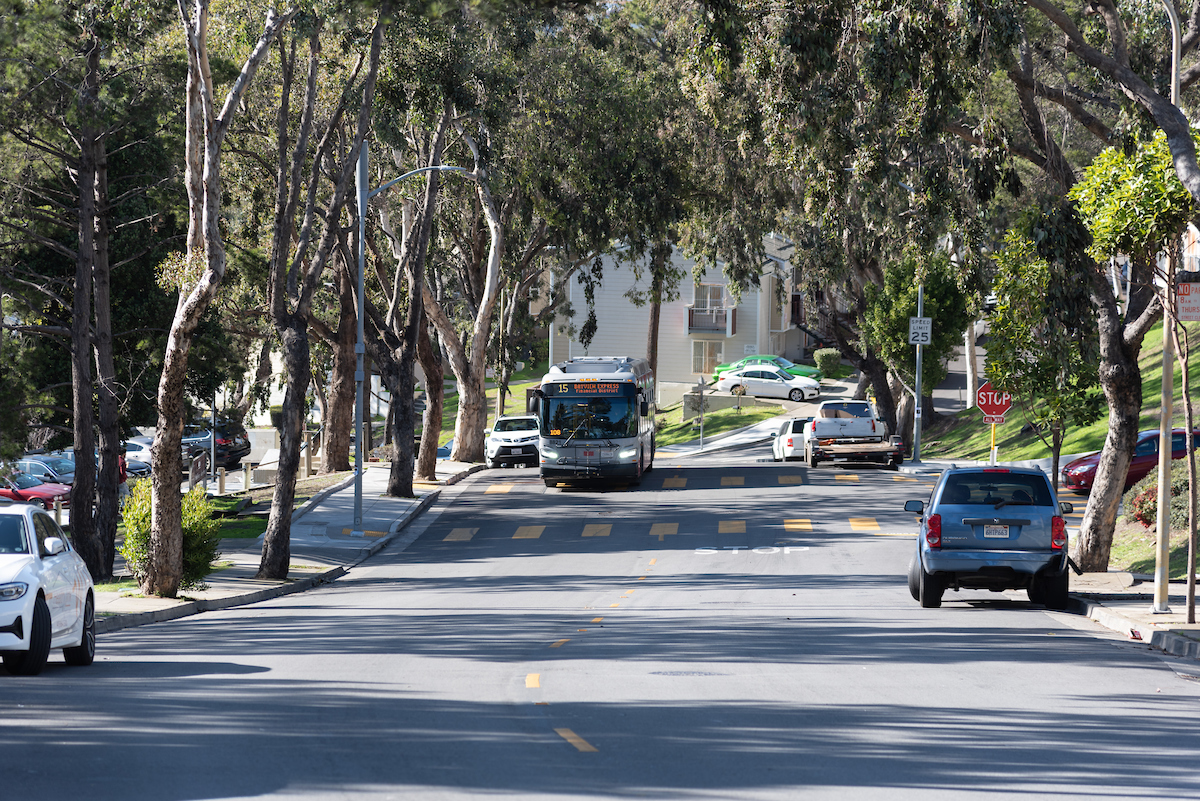
A 15 Bayview Hunters Point Express bus rides down a tree-lined street in San Francisco.The 15 Bayview Hunters Point Express route will add new stops in Hunters Point and SoMa. 
Beginning Saturday, Jan. 20, the SFMTA will be adjusting Muni service on some routes to address crowding, including for school travel times. We’re also making several stop changes based on rider feedback and our own observations to add new connections and make Muni more reliable. 

New Connections on the 15 Bayview Hunters Point Express 

Since it launched in early 2021, the 15 Bayview Hunters Point Express route has been a key connector between neighborhoods. Connecting Bayview-Hunters Point, Dogpatch, Mission Bay, SoMa and the Financial District, the route was initially designed based on community input. Now we’re adding stops at two locations based on feedback from riders and operators: 

  • Hudson Avenue and Cashmere Street will have new stops for both inbound and outbound trips. We’ve heard from residents in Hunters Point that the 15 Bayview Hunters Point Express fills a unique need, but existing stops are spaced far apart. 

  • Near the 4th and King Caltrain Station, new stops are being added at 3rd and Brannan streets (inbound) and 4th and Berry streets (outbound) to create a new connection for riders looking to transfer between Muni and Caltrain. As part of this change, the stop nearby at 4th & King streets served by the T Third bus and 91 Third Street bus will be relocated a half-block south to help with congestion at the 4th and King streets intersection. 

To reflect the travel time of the route more accurately, we are updating the weekday frequency from every 10 minutes to every 12 minutes. We will still be dedicating the same resources to this route, but this frequency reflects the actual travel time along the route and is expected to improve reliability for 15 Bayview Hunters Point Express riders. 

Balancing Service to Address Crowding 

Since the 2023-2024 school year started in August, we’ve heard from families and observed crowding on some lines that serve schools, especially during morning commute times. At times the bus is so full that it must pass up waiting riders. We’ve also noticed that some popular routes are crowded throughout the day. As a result, we are making small frequency increases.  

Increased frequency at select weekday times: 

Increased frequency on weekends: 

The SFMTA continues to face financial constraints that limit our ability to expand service. That means that adding service on any route requires taking it from another route. As a result, we are monitoring ridership across routes to address changing travel patterns and only adding service where crowding is an issue. To increase frequency on the above routes, we must decrease weekday frequency on others.

Decreased weekday frequency: 

  • 5 Fulton and 5 Fulton Rapid with combined local and rapid frequency will change from every 4.5 minutes to every six minutes. Additionally, the 5 Fulton will change from every nine minutes to every 10 minutes on weekends. 

  • 9 San Bruno with combined local and rapid frequency will change from every 5.5 minutes to every six minutes. 

  • 33 Ashbury/18th Street frequency will change from every 15 minutes to every 20 minutes. 

Other Stop Changes 

  • As part of the 16th Street Improvement Project, the 22 Fillmore stop at 16th and Dolores streets will move from the nearside of the intersection to the far side. This move will be made in both directions to improve reliability and travel times. Existing shelters will be relocated to the new stop locations. 

  • The 58 Lake Merced stop at Sunset Boulevard and Lake Merced Boulevard will be removed in both directions to improve reliability and travel time. This low-ridership stop has poor connectivity to nearby streets and is just a two-minute walk or roll (less than 500 feet) from stops at Sunset Boulevard and Ocean Avenue, which are wheelchair accessible and include seating.

Safety is always a priority on Muni. If you experience or witness customer or operator harassment on Muni, report it directly to the SFMTA by calling 311 or using the 311 mobile app or the Muni Feedback form (SFMTA.com/MuniFeedback).


Published January 03, 2024 at 12:22PM
https://ift.tt/9JMPGKp

Friday, 22 December 2023

Celebrate the Holidays at Union Square with Muni

Celebrate the Holidays at Union Square with Muni
By Che Harmon

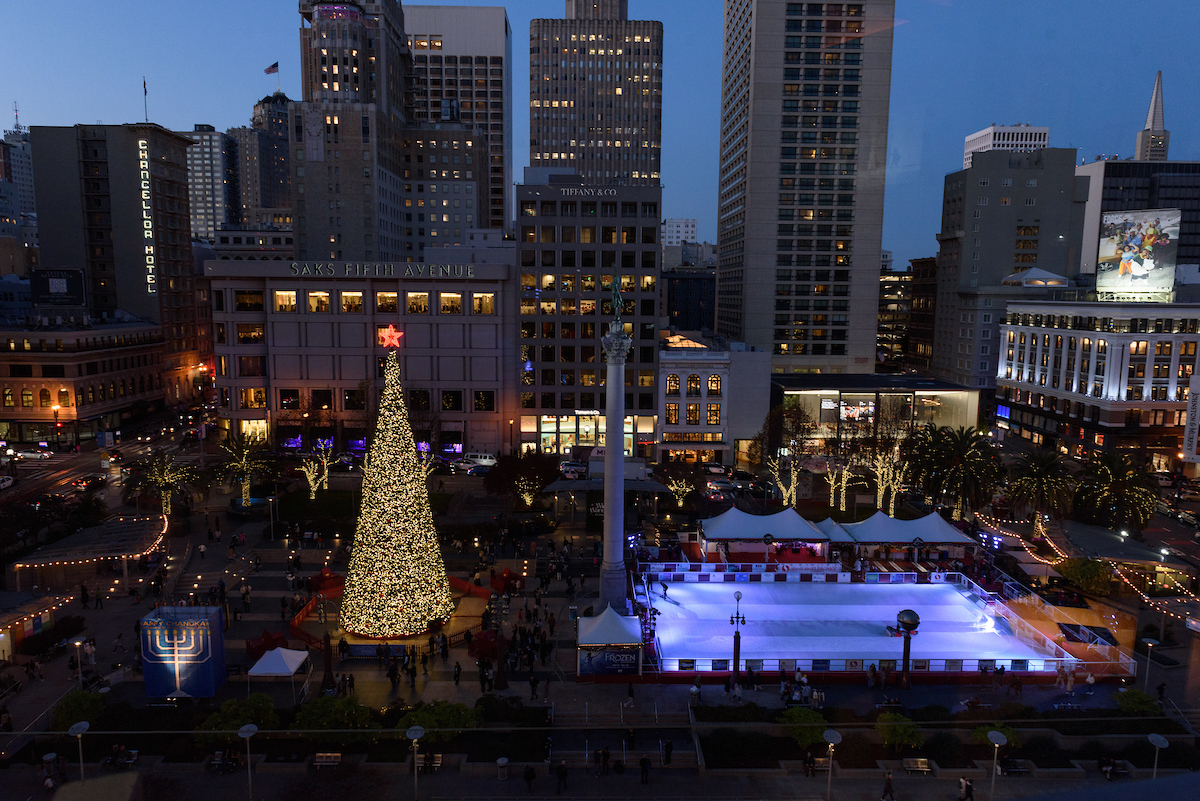
Picture of Christmas Tree and Ice-Skating Rink in Union Square.Holiday Scenes in Union Square.

As 2023 comes to an end, the holiday festivities in San Francisco are just beginning. Muni is your ride to the Union Square Christmas Tree, Ice Skating Rink and the return of Winter Walk.  

The holidays at Union Square are a San Francisco tradition, and all of its festive attractions are easily accessible by Muni. Take Muni to Union Square to enjoy the iconic Christmas tree and ice-skating rink through Jan. 15 or take a stroll through Winter Walk and its wonderland design through Dec. 24. Enjoy Winter Walk's entertaining shows, food trucks, shopping booths and more, all making their festive return from a 5-year-break. Union Square is accessible through the Union Square/Market Street and Powell stations, as well as many other Muni lines that make it easy to get to.  

We are also excited to continue our tradition of free Muni rides on New Year’s Eve starting from 8 p.m. on Saturday, Dec. 31 through 5 a.m. on Sunday, Jan. 1. Clipper Card customers should NOT tap their cards to make sure they don’t get charged a fare, and Muni Mobile passes will not be necessary. We are happy to provide this free Muni service as part of our ongoing commitment to Vision Zero. Plan your travel to ring in 2023 at our New Year’s Eve Travel & Transit webpage (SFMTA.com/NYE). 

Riding transit is the safest way to enjoy the holiday season and its events. Taking Muni lets you and your loved ones celebrate without the hassles of traffic and parking. 

Plan your Holiday adventures at our website SFMTA.com. 


Published December 22, 2023 at 10:12AM
https://ift.tt/uBygpJn

Thursday, 21 December 2023

How Your Feedback is Shaping the Bayview Community Shuttle

How Your Feedback is Shaping the Bayview Community Shuttle
By Hana O’Neill

A new community shuttle is coming to Bayview-Hunters Point in 2024, and we need your help designing it! The SFMTA is partnering with the California Air Resources Board and nine community-based organizations to launch a dynamic service community shuttle that truly meets your needs. The shuttle is funded through California Climate Investments, a statewide initiative that puts billions of Cap-and-Trade dollars to work reducing greenhouse gas emissions, strengthening the economy and improving public health and the environment — particularly in disadvantaged communities. 

A “dynamic service” shuttle is one that doesn’t have a fixed route like a bus line, but instead operates in a “service area.” The shuttle will pick up and drop off riders throughout the service area, which can help you reach destinations that were previously hard to get to. The Bayview is a geographically isolated community and the community identified the need for a shuttle like this in the Bayview Community Based Transportation Plan. 

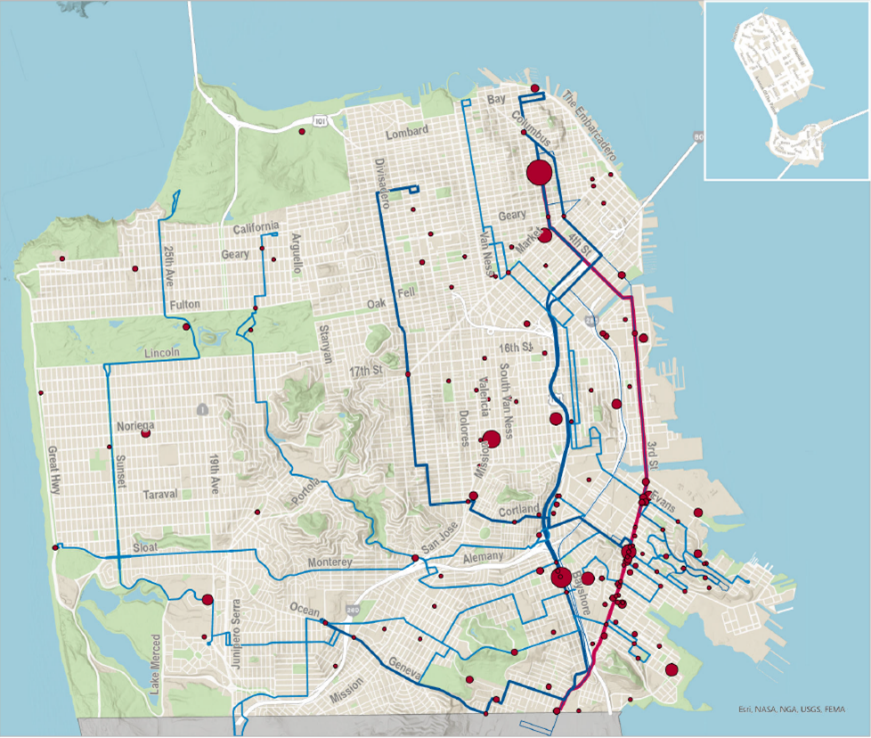
We’re currently working on defining that service area. We’ve held 28 events where we talked to almost 2,000 residents, but we know not everyone can come to community meetings or other events. So we also conducted a survey that residents filled out online or on paper at outreach events. We surveyed 629 residents, who gave us 1,060 places they wanted to take a shuttle to. Here’s a summary of the results: 

Many people wanted to take short trips that start and end within the Bayview. 76 people told us that they wanted connections to specific transit lines, such as to the T Third. Others gave destinations that are easily accessible via already-existing Muni lines, such as Chinatown. While a shuttle may not be able to take you all the way to that destination, a direct lift to the T Third would make that trip much easier. 

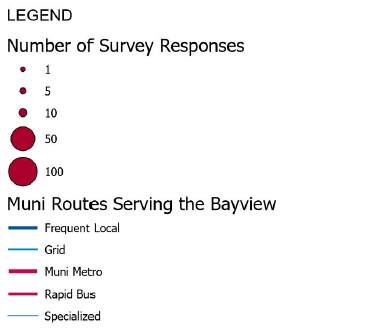
A legend for a map of San Francisco displaying Muni Routes that serve the Bayview and frequency of survey responses. Most survey responses are in the Bayview or along Muni routes. Frequently requested destinations include Chinatown, Downtown, 24th St BART, the San Bruno Ave commercial corridor, and SF General Hospital.A map of San Francisco displaying Muni Routes that serve the bayview and frequency of survey responses. Most survey responses are in the Bayview or along Muni routes. Frequently requested destinations include Chinatown, Downtown, 24th St BART, the San Bruno Ave commercial corridor, and SF General Hospital.

Desired destination of survey respondents.


Initial Service Plan/Alternative A: 

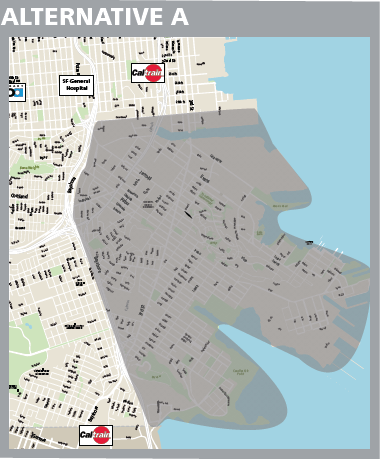
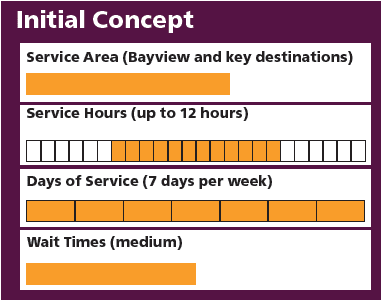
The initial service plan that we presented to residents included service from 7 a.m. to 7 p.m., seven days a week. Riders would wait up to 15 minutes for a ride to Bayview destinations, as well as a few others outside of the neighborhood, such as the 22nd Street Caltrain station, 24th Street BART station and Zuckerberg San Francisco General Hospital.  

The initial concept shows a map of the service area including the Bayview itself, and 3 potential external destinations: 24th St BART, 22nd St Caltrain, and SF General Hospital. This alternative would have approximately 12 hours of service 7 days a week, a moderately large service area, and moderate wait timesA chart depicting the service hours related to the Alternative A map: this alternative would have approximately 12 hours of service 7 days a week, a moderately large service area, and moderate wait times

Alternative A: Initial conception of service plan.


Alternative B: 

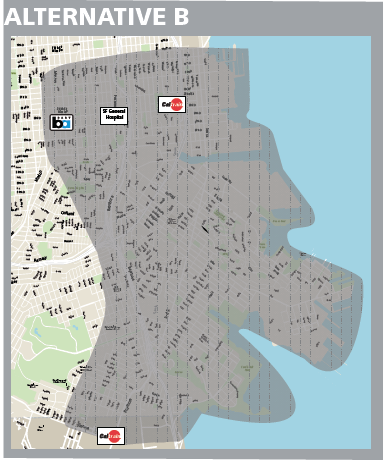
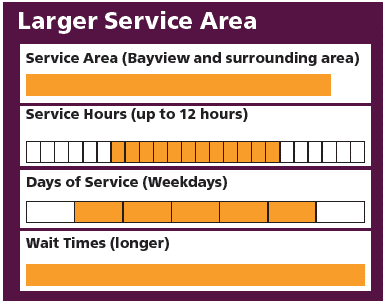
How does this plan sound to you? Would you rather have a larger service area for the shuttle so that you could be picked up or dropped off in neighboring areas (shown in gray in the Alternative B map)? This alternative would require running service for a shorter time period – for instance, operating only on weekdays – and with longer wait times. Is this tradeoff worth it? We’d love to hear from you. 

The larger service area alternative B shows a map of the service area including the Bayview itself, and many neighboring areas, potentially including Potrero Hill, the Mission, and parts of the Portola and Visitacion Valley, though exact borders have not been determined. This alternative would have approximately 12 hours of service 5 days a week, a large service area and longer wait times.A graphic chart depicting the service hours related to the Alternative B map. This alternative would have approximately 12 hours of service 5 days a week, a large service area, and longer wait times.

Alternative B: Larger service area and tradeoffs


Alternative C: 

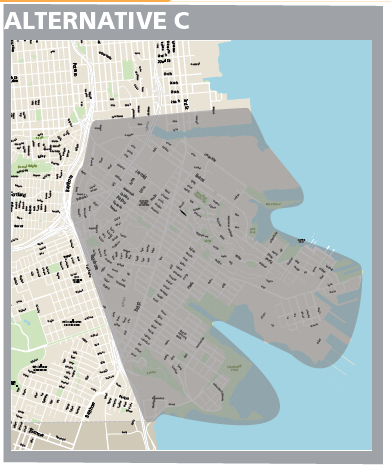
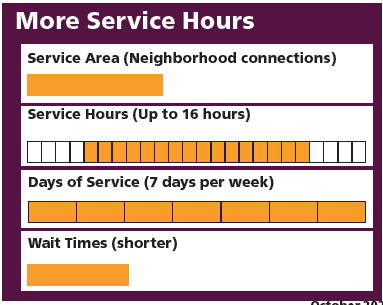
We could also run the shuttle for a longer time period, such as from 6 a.m. to 10 p.m., seven days a week, with short wait times – but this would require focusing on local neighborhood connections. The shuttle would serve only the Bayview, with no destinations outside of the neighborhood. 

Alternative C shows a map of the service area including immediate neighborhood connections within the Bayview. This alternative would allow us to run approximately 16 hours of service 7 days per week, and allow shorter wait times, but leaves a smaller service area. A chart reflecting the more service hours found in the Alternative C map of the service area including immediate neighborhood connections within the Bayview. This alternative would allow us to run approximately 16 hours of service 7 days per week, and allow shorter wait times, but leaves a smaller service area.

Alternative C: More service hours and tradeoffs


Would you rather be able to go more places, even if that means you wait longer, and the shuttle doesn’t run for as many hours of the day? Or would you rather get a ride more quickly, at more times of day, even if it can’t take you directly to as many locations? Please let us know what you think! 

You can sign up for project updates here to learn about upcoming meetings, including our Community Congress on January 24th. You also can email us at BayviewShuttle@sfmta.com.  

As we continue to do outreach to hear about your priorities, we’re also working to select a company to run this shuttle service. When all is said and done, we’re hoping to start service by the middle of 2024. 


Published December 21, 2023 at 11:20AM
https://ift.tt/WeoA4ws

Wednesday, 20 December 2023

Take Muni for Free on New Year’s Eve 2023

Take Muni for Free on New Year’s Eve 2023
By Janice Tan

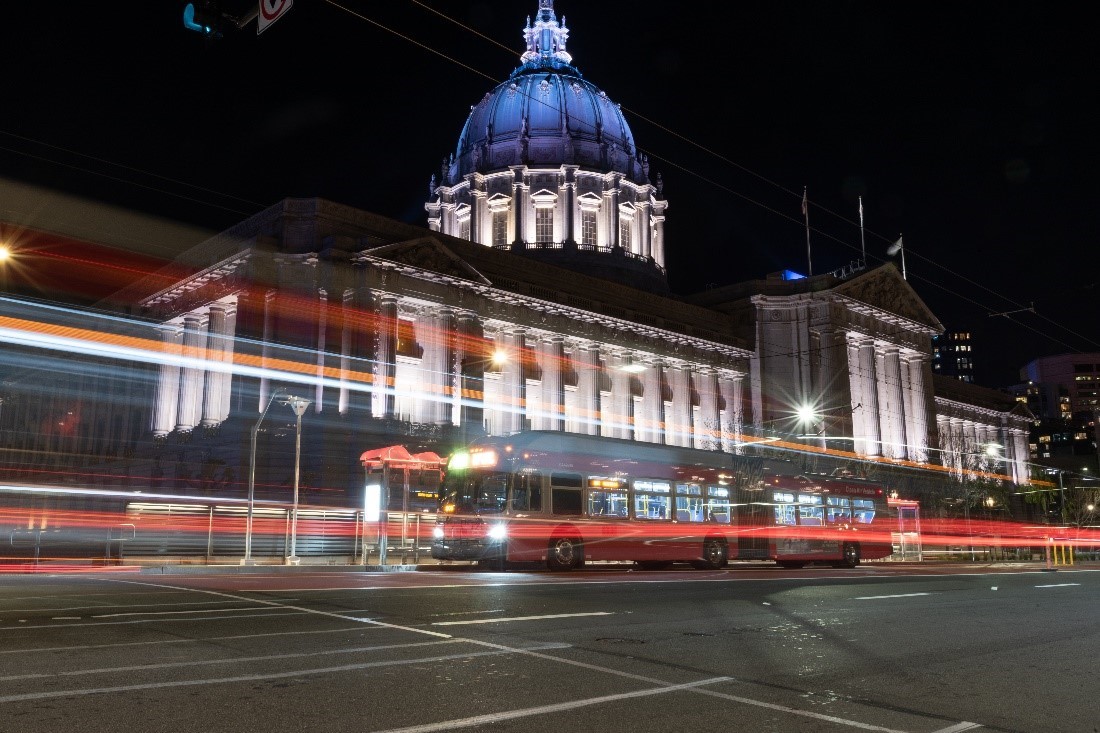
A night time photo of San Francisco's city hall with a Muni bus driving by.Ride Muni for free during New Year's Eve. 
As the year comes to an end, we in San Francisco have a lot to celebrate. To keep that celebration safe, we are offering our 24th consecutive year of free Muni rides for all customers on New Year’s Eve. Let Muni be the designated driver for free from 8 p.m. on Sunday, Dec. 31 through 5 a.m. on Monday, Jan. 1.  

Clipper Card customers should NOT tap their cards to make sure they don’t get charged a fare. MuniMobile passes will not be necessary. Metro fare gates will be open on New Year’s Eve starting at 8 p.m. 

Riding transit is the safest way to celebrate New Year’s Eve in San Francisco, and we are happy to provide free Muni service as part of our ongoing commitment to the city’s Vision Zero goal of eliminating traffic fatalities.  

Whether your New Year’s resolution includes reducing your climate footprint, trying new restaurants or using more active transportation modes for better health, taking Muni on New Year’s Eve is a great choice to start your year with. 

New Year’s Eve Muni Service 

  • Free Muni service from 8 p.m. on Sunday, Dec. 31 through 5 a.m. on Monday, Jan. 1 

  • Metro fare gates will be open starting at 8 p.m. on New Year’s Eve 

  • Do not tag your Clipper Card or activate a MuniMobile ticket 

  • Start planning your trip at SFMTA.com 


Published December 20, 2023 at 09:32AM
https://ift.tt/cRX5eLv

Tuesday, 19 December 2023

SFMTA Introduces First LRV4s with New Seating Arrangement

SFMTA Introduces First LRV4s with New Seating Arrangement
By Che Harmon

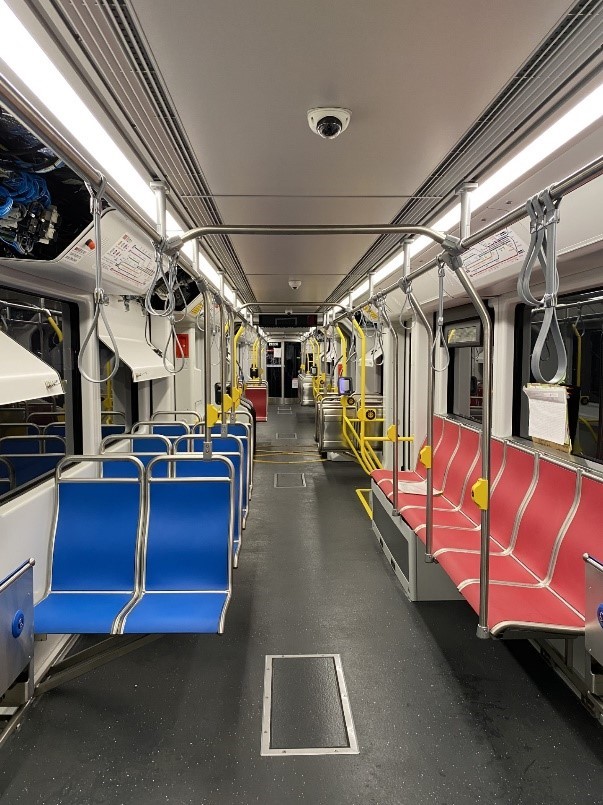
The interior of a train with blue double seats facing forward on one side and a row of red seats facing the aisle on the other.

New seating arrangement in LRV4 vehicles with seats facing the front or rear. 

At the SFMTA, we’re committed to improving service every way we can, and your input is critical to doing it. Our LRV4 Muni fleet is newer and easier to clean and maintain. These state-of-the-art vehicles are helping us make dramatic improvements in Muni reliability, but we’ve heard consistently that passengers want more seating options. We’re listening and putting your feedback into action. 

In early September, we introduced the addition of side-by-side seats facing the front or rear of the vehicle, also known as “transverse” seats. Car #2120 was the first of a hundred LRV4 cars to feature a revamped interior. This seating arrangement lets passengers choose whether they want to face forward or backwards, depending on the direction the train is headed. 

The original interiors in Muni’s LRV4 fleet featured a bench arrangement that ran along the outer walls of the cars, with seats that face inward towards the center aisle of the train and lacked the “butt-dimples” passengers were accustomed to seeing. This layout allowed more people to ride on each train car, which is important, but some passengers found the seating uncomfortable and wanted more places to sit. Your comfort and input are also important, and those older interiors are almost gone now. They’ve been replaced with updated seating featuring the return of the “butt-dimples” for a more comfortable ride. 

While all vehicles are being updated to include transverse seats, only our newer LRV4 vehicles have been equipped with double-transverse seating options, as this change required structural reinforcement to support the extra weight of two passengers.  

The LRV4s with the double-transverse seats will be the final phase of LRV4 vehicles joining the Muni fleet before a preventative brake rebuild. This $20 million overhaul and upgrade will improve reliability and extend the manufacturer’s warranty on our new vehicles. 

As these new LRV4 cars begin rolling out throughout the city, Muni passengers can look forward to a more comfortable ride. We’ll continue to update our fleet to improve your experience on Muni, and it’s your input that makes it possible. Thank you for riding Muni and helping us make it better.    


Published December 19, 2023 at 12:32PM
https://ift.tt/xUXKTzf

Friday, 15 December 2023

Climb Aboard History At Powell Plaza

Climb Aboard History At Powell Plaza
By Edward Wright

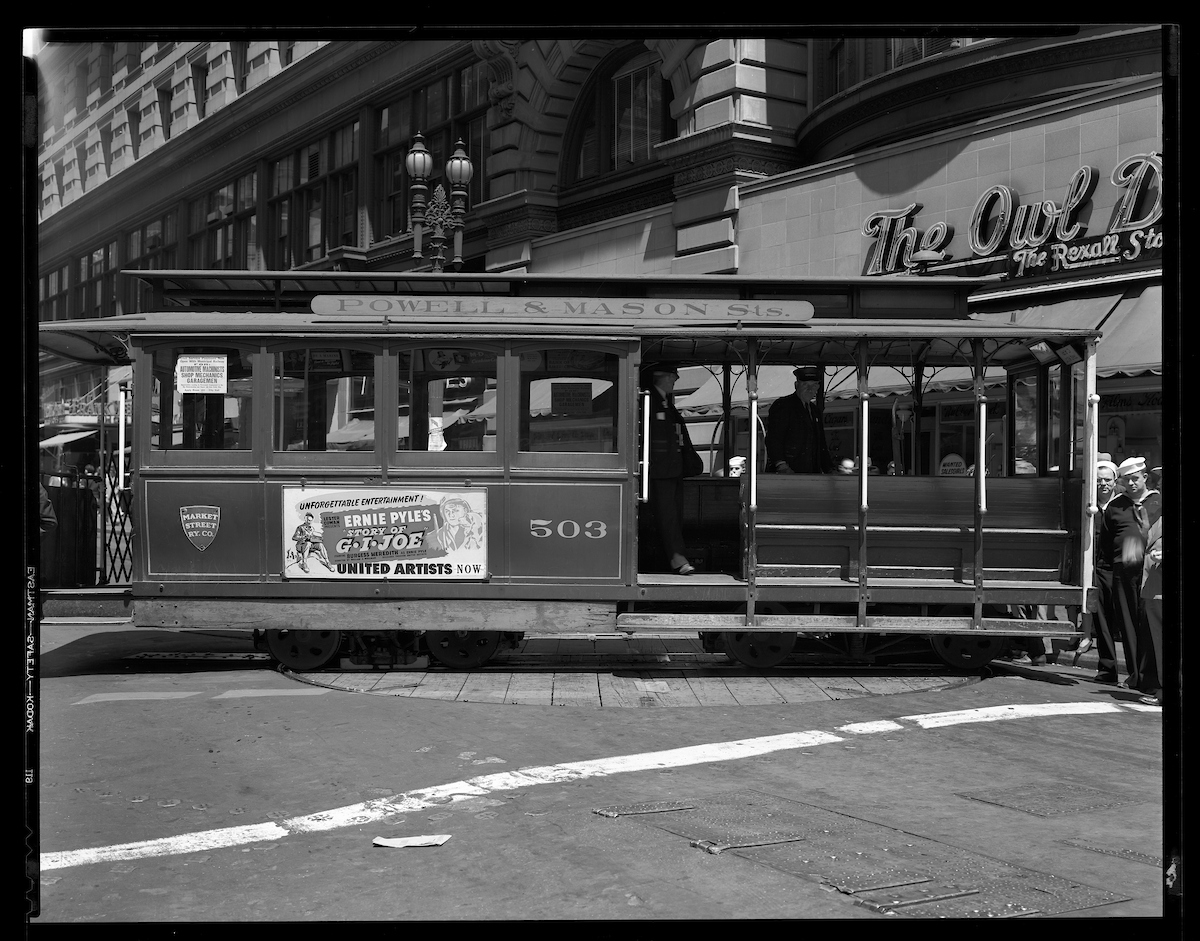
A black and white photograph of a historic cable car at Market and Powell from 1945.Powell Street Cable Car 503 at Market and Powell Street Turntable | August 13, 1945 
They’ve been sung about by Judy Garland and saved by Dianne Feinstein, and now you can experience San Francisco’s historic cable cars in a brand-new way at Powell Plaza.  

Starting this Saturday, Dec. 16, a 150-year-old cable car will be stationed at Powell Plaza every Tuesday and Saturday from 7 a.m.-7 p.m., weather permitting. Visitors and residents can climb aboard history, take photos and explore this mobile museum up close. 

A true San Francisco original, cable cars were first invented right here in the city in 1873 by Andrew S. Hallidie. Our street-running cable car system is the only one of its kind remaining in the entire world, and San Francisco’s cable cars are a designated National Historic Landmark. 

This pilot activation at Powell Plaza is a unique opportunity to learn about the history of these iconic vehicles and experience them for free and up close. SFMTA’s cable car ambassadors will be on site to share information and answer your questions.  

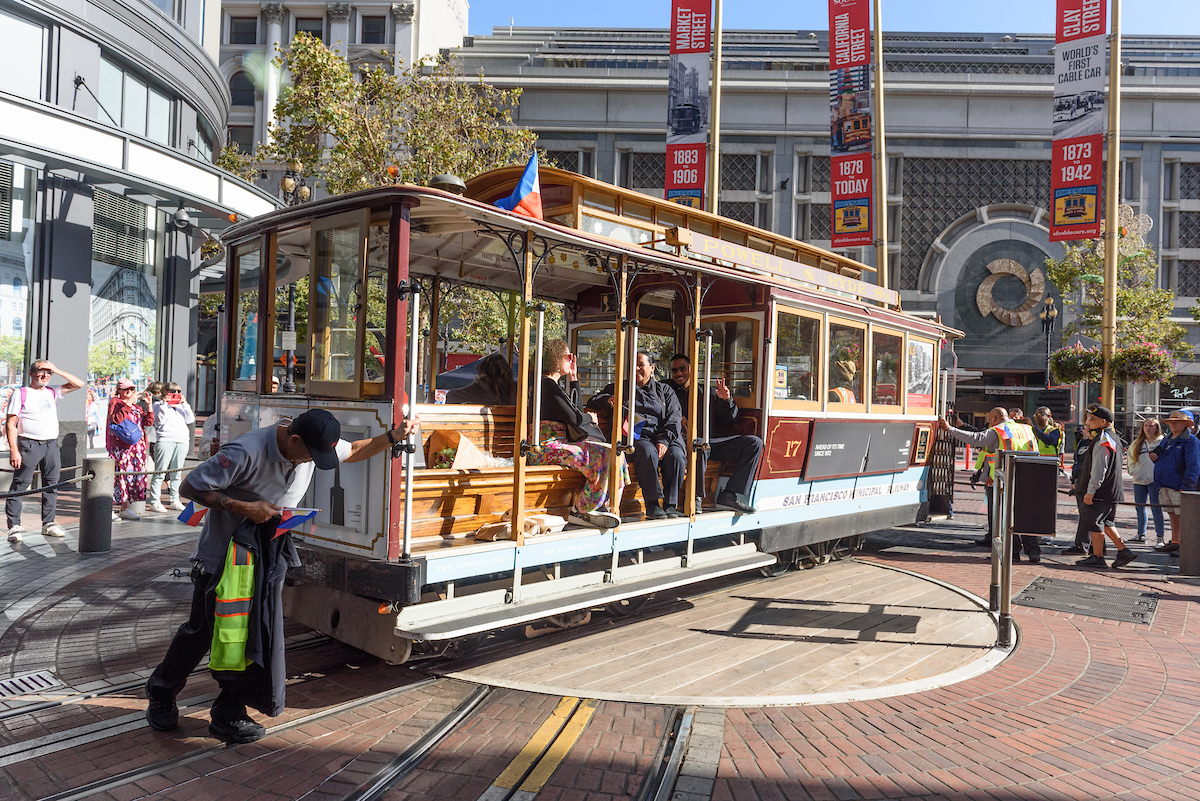
A cable car is rotated at the Powell Plaza turnaround by SFMTA operators.Cable Car ride to celebrate Filipino American History Month | October 11, 2023

Visitors have flocked to the cable car turnaround at Powell Plaza for generations, and few symbols capture the imagination and magic of San Francisco like our cable cars. Whether you’re visiting the city for the first time, or are a life-long San Franciscan, this pilot activation makes it easier than ever to experience some cable car magic, connect with local history and take a photo souvenir.  

This pilot project is a partnership between the SFMTA and Mayor London Breed, to highlight a piece of our history and support downtown activation -- just in time for the holidays. This pilot is being offered for a limited time only, so don’t wait to climb aboard.  

Can’t get enough of our cable cars? Learn about the cultural connections our cable cars celebrate and support in the latest episode of the SFMTA’s Taken with Transportation podcast on our podcast webpage (SFMTA.com/Podcast). Explore more Muni history at the “120 Years: SFMTA Photo Archive 1903-2023” exhibit at the Harvey Milk Photo Center.  


Published December 15, 2023 at 02:32PM
https://ift.tt/Kmz1ds7